Business Fiber Internet vs. Dedicated Internet Access (DIA): Architecture, Cost, and SLA Comparison
Compare shared business fiber broadband with Dedicated Internet Access (DIA). Learn about network architecture, SLAs, symmetrical speeds, build-out costs, and contract terms.
Understanding Enterprise Connectivity Options
Choosing the right network infrastructure is a foundational decision for modern operations. Organizations rely heavily on cloud-hosted applications, Voice over Internet Protocol (VoIP) communications, continuous off-site backups, and real-time data processing. When selecting an enterprise network connection, decision-makers usually evaluate two distinct options: standard business fiber broadband and Dedicated Internet Access (DIA). Both solutions transmit data using fiber-optic lines, but their underlying network architecture, performance guarantees, and financial structures differ significantly.
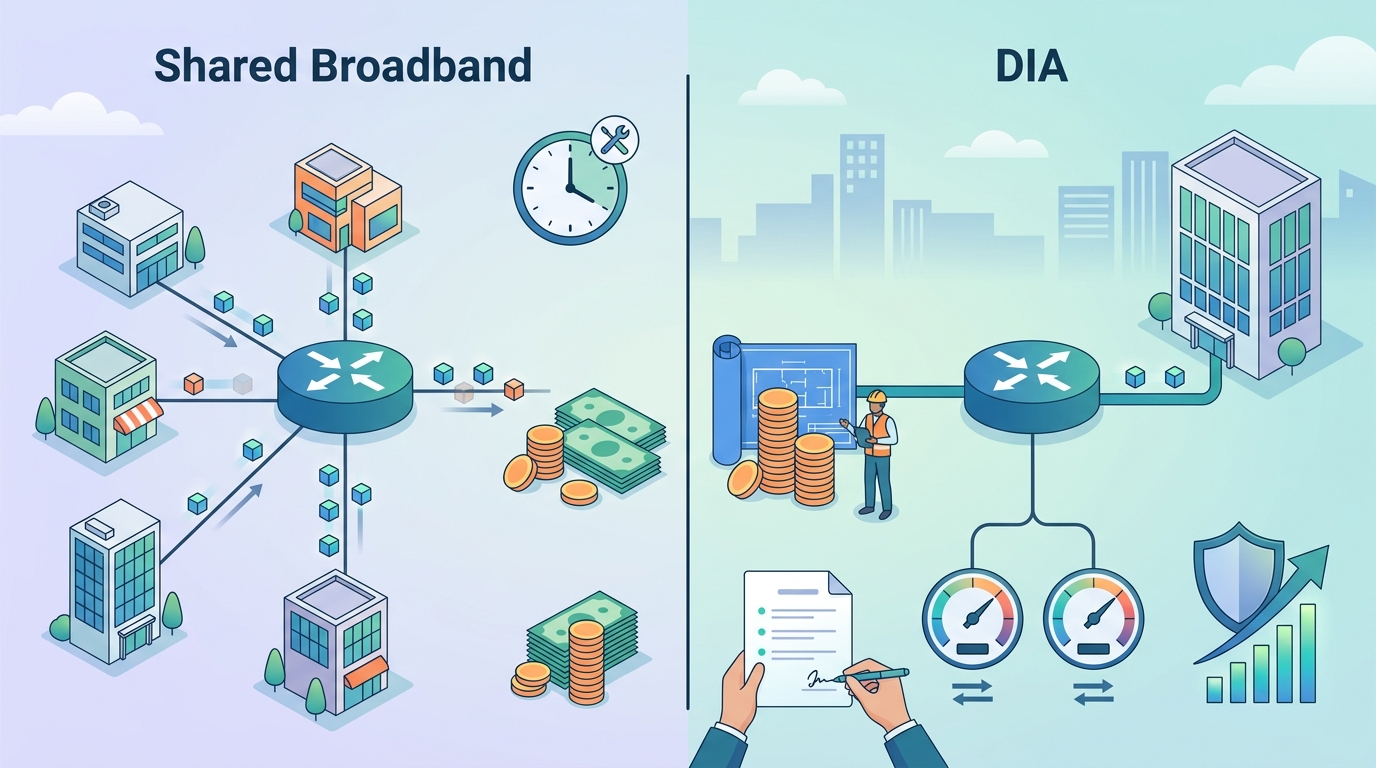
Standard business fiber broadband operates on a shared infrastructure model where multiple subscribers split bandwidth capacity. In contrast, DIA delivers a private line exclusively reserved for a single customer. The Federal Trade Commission (FTC) emphasizes that businesses should carefully review contract terms and bandwidth disclosures to ensure advertised speeds align with actual daily performance (Source 1). Furthermore, standard-setting bodies like the ITU Telecommunication Standardization Sector (ITU-T) establish framework specifications for network architectures and quality-of-service parameters that define how these circuits function (Source 2). This comprehensive comparison analyzes the technical architecture, financial commitments, service level agreements (SLAs), and operational trade-offs of business fiber broadband versus DIA.
Architecture Differences: Shared PON vs. Point-to-Point Dedicated Fiber
The primary structural difference between standard business fiber and dedicated internet access lies in how traffic travels between the customer premises and the service provider’s core network. Standard business fiber broadband typically uses Passive Optical Network (PON) architecture. In a PON setup, a single optical fiber strand leaves the provider's central office and passes through unpowered optical splitters. These splitters divide the signal to serve anywhere from 16 to 64 individual end-user locations.
Because PON relies on shared physical capacity, it introduces oversubscription. Service providers calculate bandwidth provisioning assuming that not all connected businesses will utilize maximum throughput simultaneously. During peak operating hours, network congestion can occur on shared nodes, leading to temporary speed drops, higher jitter, and increased latency. ITU-T standards for Gigabit Passive Optical Networks (G-PON and XGS-PON) define maximum downstream and upstream bandwidth limits across shared trunks (Source 2).
Dedicated Internet Access relies on a point-to-point (P2P) circuit topology. A dedicated fiber strand connects the subscriber directly to the Internet Service Provider (ISP) point of presence (POP) without sharing physical strand capacity or central office splitters. The bandwidth allocated to a DIA circuit is unthrottled and completely unshared. If an enterprise purchases a 1 Gbps DIA connection, that 1 Gbps capacity remains continuously available regardless of neighborhood traffic patterns or local network usage peaks.
Financial Comparison: Shared Fiber vs. Dedicated Internet Access Costs
Pricing models reflect the architectural differences between shared business fiber and dedicated circuits. Standard business fiber internet is priced as a mass-market utility service. Prices generally range from $100 to $300 per month for bandwidth options ranging between 100 Mbps and 1 Gbps. The low monthly cost is enabled by the provider's ability to amortize infrastructure expenses across dozens of subscribers sharing the local PON splitter node.
Dedicated Internet Access requires a higher financial allocation due to reserved core capacity and proactive operational monitoring. Enterprise fiber pricing for DIA generally ranges from $500 to $2,000+ per month depending on symmetrical bandwidth requirements, geographic location, and contractual SLA terms. Lower bandwidth DIA connections, such as 100 Mbps dedicated lines, may start around $400 to $600 per month, while symmetrical 10 Gbps DIA circuits can exceed $3,000 to $5,000 per month in specialized enterprise environments.
| Feature / Metric | Shared Business Fiber Broadband | Dedicated Internet Access (DIA) |
|---|---|---|
| Typical Monthly Cost | $100 – $300 / month | $500 – $2,000+ / month |
| Network Architecture | Shared Passive Optical Network (PON) | Point-to-Point (P2P) Dedicated Fiber |
| Oversubscription Ratio | Shared (e.g., 16:1 to 64:1 split) | 1:1 Unsubscribed (Guaranteed) |
| Uptime Guarantee (SLA) | Best-effort or basic (99.0% – 99.9%) | Financially backed (99.99% typical) |
| Mean Time to Repair (MTTR) | Best-effort (24 – 48 hours typical) | Strict target (4 hours typical) |
| Bandwidth Delivery | Variable during peak usage hours | Symmetrical & constant 24/7/365 |
| Static IP Allocation | Available for extra fee ($10–$30/mo) | Included or easily scalable |
Decoding Service Level Agreements (SLAs) and Uptime Guarantees
A primary distinction between shared business fiber vs DIA is the presence of a binding Internet Service Level Agreement (SLA). Standard business fiber connections are usually sold on a "best-effort" basis. While carriers aim to maintain high availability, business broadband plans rarely offer financial compensation or contractual recourse if service drops out during business hours.
DIA contracts include a legally binding SLA that outlines enforceable performance thresholds. Key SLA metrics typically include:
- Network Availability: Standard DIA SLAs guarantee 99.99% uptime (often referred to as 'four nines'). This benchmark allows for no more than 52.6 minutes of unscheduled downtime per calendar year.
- Mean Time to Repair (MTTR): In the event of a fiber cut or hardware failure, DIA contracts specify a strict MTTR, typically 4 hours from initial ticket creation. If the provider fails to restore service within this window, the customer receives automated financial bill credits.
- Latency Guarantees: DIA SLAs establish maximum allowable round-trip latency limits, usually under 45 milliseconds for North American regional transport, keeping real-time applications responsive.
- Packet Loss Thresholds: Dedicated contracts mandate packet loss benchmarks of less than 0.1% to 0.5% across the provider's core network infrastructure.
ITU-T Recommendation Y.1541 specifies network performance objectives for IP-based services, establishing internationally recognized frameworks for packet transfer delay and loss rates that enterprise SLAs build upon (Source 2). FTC consumer and business guidance notes that service providers must accurately represent performance guarantees in marketing materials and customer contracts (Source 1).
Symmetrical Internet Speeds, Latency, and Packet Loss Benchmarks
Symmetrical internet speed means that download and upload throughput capabilities are equal. Many legacy asynchronous connections (such as asymmetrical cable broadband or asymmetric DSL) offer fast downloads paired with limited upload capacity. Both business fiber and DIA can offer symmetrical bandwidth, but their actual delivery differs under operational strain.
Symmetrical bandwidth is critical for modern operations. Enterprise workloads continuously push large volumes of data upstream. Key activities requiring robust upload performance include:
- Cloud Storage and Offsite Backups: Continuous synchronization to cloud platforms like AWS, Microsoft Azure, or Google Cloud requires high upstream bandwidth to maintain tight recovery point objectives (RPO).
- VoIP and Unified Communications: Session Initiation Protocol (SIP) trunking and video conferencing require stable bidirectional throughput without packet loss to prevent audio dropouts or video freezing.
- On-Premises Application Hosting: Hosting self-managed web portals, VPN gateways, or remote desktop protocol (RDP) servers requires strong continuous upstream throughput for off-site employees.
While shared business fiber may offer symmetrical speeds on paper (e.g., 500 Mbps upload and 500 Mbps download), actual upload capacity can fluctuate during periods of localized PON congestion. Dedicated Internet Access guarantees 1:1 symmetrical bandwidth at all times, ensuring that large off-site data transfers or high-volume voice traffic do not saturate the circuit or degrade performance.
| Network Metric | Standard Business Fiber (PON) | Dedicated Internet Access (DIA) |
|---|---|---|
| Bandwidth Allocation | Asymmetrical or Shared Symmetrical | Guaranteed 1:1 Symmetrical |
| Latency Stability | Variable during peak utilization | Low, bounded by contract (<45ms) |
| Packet Loss Benchmark | Not guaranteed (Best-effort) | Contractually backed (<0.1%) |
| Oversubscription Risk | Possible during local node peaks | None (Dedicated circuit capacity) |
Negotiating Build-Out Fees, Static IPs, and Contract Terms
Procuring dedicated internet access cost structures involves contract elements not typically present in standard broadband ordering. Organizations evaluating enterprise fiber pricing should carefully navigate three main components during contract negotiations: construction costs, static network numbering, and commitment length.
Special Construction and Build-Out Fees
If a commercial building lacks an existing fiber entrance or splice box, bringing a dedicated line into the facility requires physical trenching, conduit placement, and fiber installation. These build-out costs (also known as special construction charges) can range from $2,000 to over $20,000 depending on distance from the nearest carrier optical tap.
Carriers frequently offer build-out fee waivers or construction allowances in exchange for multi-year contract commitments. For example, signing a 36-month or 60-month DIA agreement often prompts the carrier to absorb up to $10,000 in upfront construction expenses.
Static IP Allocation and IPv6 Block Routing
Shared business fiber connections typically assign dynamic IP addresses by default, charging an extra fee of $10 to $30 per month for a single static IP address. Dedicated Internet Access packages usually include a block of static IP addresses (such as a /29 or /28 IPv4 subnet) at no additional charge. Static IP addresses are essential for running site-to-site IPsec VPN tunnels, hosting local email or web infrastructure, and managing restricted firewall access control lists.
Contract Term Lengths and Early Termination Penalties
Standard business broadband is often sold on month-to-month terms or annual agreements. Dedicated Internet Access generally mandates multi-year contracts (typically 24, 36, or 60 months). IT directors should examine early termination liability clauses before signing. The FTC advises businesses to review termination fees and automatic renewal windows to maintain financial flexibility (Source 1).
Strategic Recommendation: Matching Architecture to Business Needs
Determining whether to deploy standard business fiber broadband or Dedicated Internet Access depends on an evaluation of application sensitivity, cost of downtime, and operational reliance on real-time data transmission.
Standard business fiber broadband is well-suited for micro-businesses, retail stores, small branch offices, or organizations where brief internet interruptions do not trigger immediate financial losses. For these scenarios, paying $100 to $300 per month delivers sufficient speed for basic web browsing, cloud software-as-a-service (SaaS) access, and standard office tasks.
Dedicated Internet Access is essential for medium-to-large enterprise headquarters, healthcare facilities, financial services firms, e-commerce operations, and data centers. In these environments, an unexpected outage or severe latency spike can halt production, disrupt customer transactions, or compromise compliance protocols. The higher monthly cost of DIA serves as financial insurance, securing continuous throughput, immediate repair priority, and verifiable operational performance.
What is the key difference between business fiber and Dedicated Internet Access (DIA)?
Standard business fiber uses a shared Passive Optical Network (PON) where bandwidth is split among multiple local subscribers. DIA provides a private, unshared point-to-point fiber connection directly to the carrier network with guaranteed symmetrical speeds and a binding Service Level Agreement (SLA).
How much does Dedicated Internet Access cost compared to business broadband?
Standard business fiber broadband typically costs $100 to $300 per month. Dedicated Internet Access circuits generally range from $500 to $2,000+ per month depending on bandwidth, location, and SLA terms, reflecting the costs of reserved line capacity and dedicated support.
What happens if a DIA circuit suffers an outage?
DIA contracts include a legally binding SLA that guarantees specific uptime thresholds (usually 99.99%) and a strict Mean Time to Repair (MTTR), typically 4 hours. If the service provider fails to restore connectivity within the contractual timeframe, the business receives financial service credits.
Sources
- FTC Business Guidance Portal — Federal Trade Commission
- ITU Telecommunication Standardization Sector (ITU-T) — International Telecommunication Union
This article is for general information only and is not professional advice. Figures come from public sources and change over time; check the official source before you act.
More from Real Money Net
- Heat Pump HVAC Conversion Costs: Federal Rebates, Tax Credits, and System Sizing
- Business Fiber Internet vs. Dedicated Internet Access (DIA): Architecture, Cost, and SLA Comparison
- International Medical Evacuation and Travel Health Coverage: Policy Limits and Out-of-Country Costs
- Used EV Tax Credit Rules: Eligibility, Income Caps, and Battery Degradation Checks
- Commercial Auto Insurance Coverage: Liability Limits, Business Use Rules, and Fleet Pricing
- IRS Section 25D Residential Solar Tax Credit: Sizing, Battery Rules, and ROI Calculation