Heat Pump HVAC Conversion Costs: Federal Rebates, Tax Credits, and System Sizing
Analyze total conversion costs for air-source, ductless, and geothermal heat pumps. Learn how Section 25C tax credits and state HEEHRA rebates offset installation expenses.
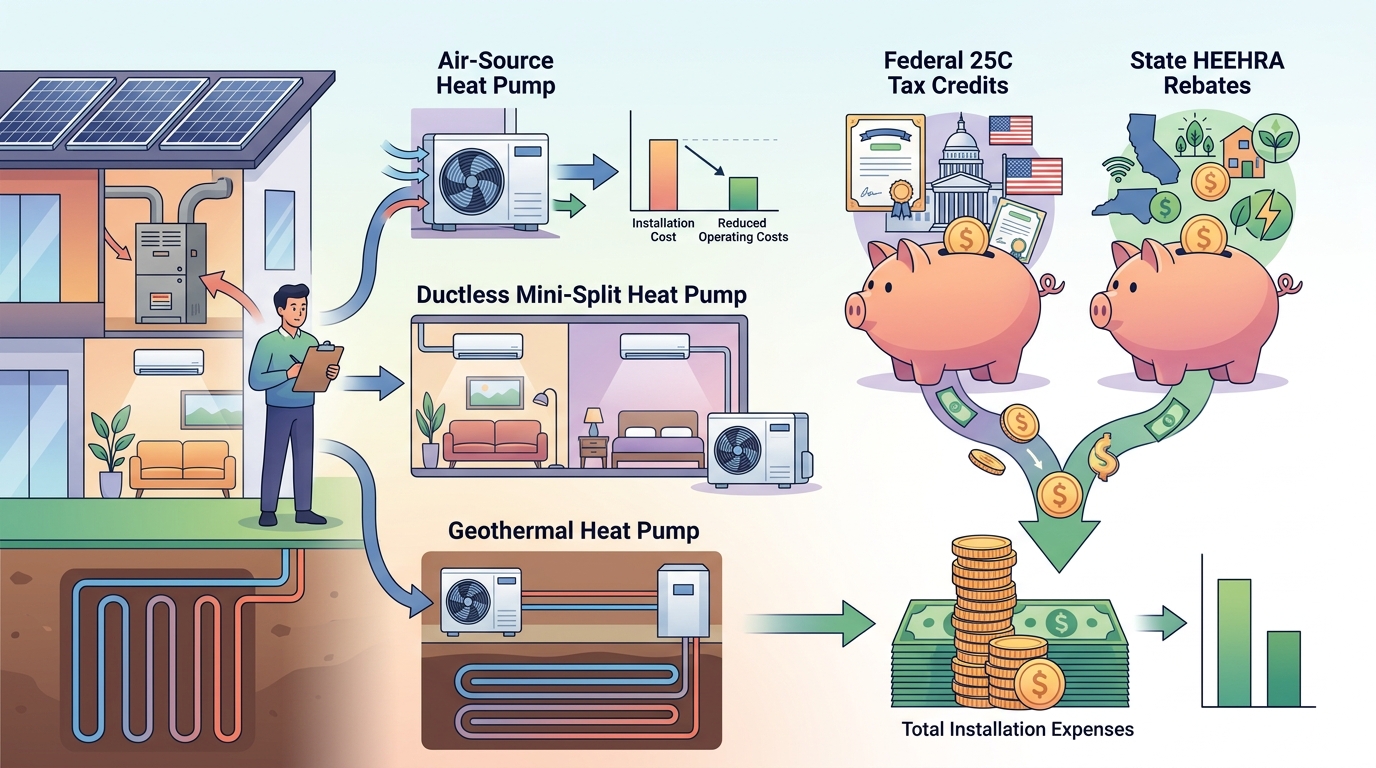
Replacing an aging fossil-fuel furnace or central air conditioner with a modern heat pump system represents a major capital investment for property owners. Recent shifts in energy policy, paired with advancement in cold-climate inverter technology, have altered the financial landscape for residential heating and cooling conversions. Understanding the total heat pump conversion cost requires evaluating equipment options, labor expenses, system sizing requirements, and available government subsidies.
System Architecture: Air-Source, Mini-Split, and Geothermal
Heat pumps function by transferring thermal energy rather than creating heat through combustion. During summer, the system extracts heat from inside the home and vents it outdoors. In winter, the process reverses, gathering ambient heat from external air or ground sources and transferring it indoors. Property owners generally select from three primary configurations:
- Ducted Air-Source Heat Pumps: These systems connect directly to existing central ductwork. They utilize an outdoor compressor and an indoor air handler to distribute conditioned air throughout the structure.
- Ductless Mini-Split Heat Pumps: Ideal for homes without existing ductwork, ductless systems use an outdoor condenser linked to one or more indoor air-handling units mounted on walls or ceilings. Each indoor unit conditions a specific zone independently.
- Geothermal (Ground-Source) Heat Pumps: These systems extract heat from the earth or ground water using sub-surface pipe loops. Ground temperatures remain relatively constant year-round, allowing geothermal systems to achieve exceptionally high operating efficiency regardless of surface weather conditions (Source 2). however, ground loop installation requires significant excavation or vertical drilling, which increases initial labor costs (Source 2).
Installation and Equipment Cost Baseline
Total project expenses vary depending on system type, heating capacity requirements, structural layout, and regional labor rates. Department of Energy data indicates that ground-source heat pump systems carry higher upfront costs than air-source units due to land preparation and loop installation expenses, though lower operating costs can offset these initial outlays over time (Source 2). Typical baseline cost ranges observed across North American residential markets are detailed below.
| System Type | Typical Capacity Range | Estimated Equipment & Labor Cost | Primary Cost Drivers |
|---|---|---|---|
| Central Ducted Air-Source | 2.0 to 5.0 Tons | $6,000 - $14,000 | Duct integrity, efficiency rating, electrical panel capacity |
| Ductless Mini-Split (Multi-Zone) | 2 to 5 Indoor Zones | $5,500 - $14,500 | Number of indoor heads, line set lengths, electrical service |
| Geothermal (Ground-Source) | 3.0 to 6.0 Tons | $18,000 - $40,000+ | Excavation/drilling type, soil condition, loop design (Source 2) |
Labor expenses typically account for 40% to 60% of total project expenditure. Projects involving complex refrigerant line routing, custom sheet metal transitions, or difficult structural access sit at the higher end of the cost spectrum.
Deciphering Efficiency Metrics: SEER2, HSPF2, and COP
Evaluating heat pump vs gas furnace efficiency requires understanding updated efficiency metrics established by the U.S. Department of Energy:
- SEER2 (Seasonal Energy Efficiency Ratio 2): Measures total cooling output during normal annual cooling seasons divided by total electric energy input. Higher ratings indicate lower electricity consumption for summer cooling.
- HSPF2 (Heating Seasonal Performance Factor 2): Measures total heating output during normal heating seasons divided by total electric energy input. Higher values signal greater seasonal heating efficiency.
- COP (Coefficient of Performance): Expresses the ratio of heat output to electrical energy input at specific test temperatures. A COP of 3.0 means the unit delivers three units of heat energy for every one unit of electricity consumed.
Traditional high-efficiency gas furnaces operate at annual fuel utilization efficiency (AFUE) ratings between 90% and 98%, meaning up to 8% of energy is lost through combustion exhaust. By contrast, air-source heat pumps operating under mild conditions routinely deliver COPs between 2.5 and 4.0, representing energy conversion efficiencies of 250% to 400%.
For properties in northern climates, cold climate heat pump cost decisions must factor in low-temperature performance. Variable-speed inverter compressors allow modern cold-climate models to maintain effective heating performance at ambient outdoor temperatures dropping to -15 degrees Fahrenheit without relying entirely on resistance backup heat.
Federal Tax Incentives: Section 25C Energy Credit
The Internal Revenue Service offers financial incentives under the Energy Efficient Home Improvement Credit (Section 25C). Taxpayers who purchase and install qualifying heat pump systems can claim an income tax credit to directly reduce their tax liability (Source 1).
- Credit Value: Eligible heat pump installations qualify for a tax credit equal to 30% of total project costs, covering equipment and labor (Source 1).
- Annual Cap: The maximum Section 25C tax credit heat pump allowance is $2,000 per tax year for qualifying heat pump systems and heat pump water heaters combined (Source 1).
- Efficiency Requirements: To qualify, air-source heat pumps must meet or exceed the highest efficiency tier established by the Consortium for Energy Efficiency (CEE) effective at the beginning of the calendar year (Source 1).
- Renewal Limits: The $2,000 heat pump limit is an annual cap rather than a lifetime maximum, allowing property owners to schedule different eligible upgrades across multiple tax years (Source 1).
Because Section 25C is a non-refundable tax credit, it reduces income tax owed dollar-for-dollar but will not result in a refund check if the credit exceeds total annual tax liability (Source 1). Property owners must claim the credit on IRS Form 5695 for the tax year in which system installation is completed (Source 1).
State Rebates: HEEHRA and HOMES Programs
In addition to federal tax credits, state energy offices administer federally funded incentive channels authorized by the Inflation Reduction Act. These programs target low- and moderate-income households to accelerate residential electrification.
High-Efficiency Electric Home Rebate Act (HEEHRA)
HEEHRA provides point-of-sale discounts for income-qualified households converting from fossil-fuel systems to electric heat pumps:
- Households earning below 80% of Area Median Income (AMI) may qualify for up to 100% of purchase and installation costs, capped at $8,000 for qualifying heat pumps.
- Households earning between 80% and 150% of AMI may receive up to 50% of costs, capped at the same $8,000 maximum threshold.
- Additional capped discounts cover supporting infrastructure, including up to $4,000 for electrical service panel upgrades and $2,500 for electric wiring.
Home Owner Managing Energy Savings (HOMES) Program
The HOMES program provides performance-based rebates based on total modeled or measured energy savings across the whole structure. Higher rebate amounts are awarded for interventions achieving modeled energy reductions exceeding 20% or 35%, regardless of fuel type.
Ancillary Upgrade Expenses: Panel and Duct Modifications
A full heat pump conversion often requires updating supporting building infrastructure. Budget planning must account for secondary electrical and air distribution modifications.
Electrical Service Upgrades
Central heat pumps and auxiliary heating elements require dedicated high-voltage circuits (240V). Older homes equipped with 100-amp main electrical service panels often lack available capacity. Upgrading to a 200-amp electrical panel generally costs between $1,800 and $4,500, depending on utility line entrance requirements and local permit fees.
Ductwork Sealing, Repair, and Resizing
Heat pumps move a larger volume of air at lower discharge temperatures than conventional gas furnaces. If existing ductwork is undersized, leaky, or uninsulated, system efficiency drops significantly. Professional duct modifications, sealing, and insulation typically add $1,000 to $3,500 to the total conversion expense.
System Sizing and Load Calculations
Proper system sizing is critical for optimizing comfort, energy efficiency, and equipment service life. HVAC contractors must perform a Manual J heat loss/heat gain load calculation before selecting heat pump equipment.
An oversized heat pump short-cycles, turning on and off rapidly. Short-cycling leads to uneven room temperatures, poor humidity control, and premature wear on compressor components. Conversely, an undersized heat pump will struggle to maintain indoor setpoints during extreme temperature events, triggering electric resistance backup heat strips that raise monthly utility bills.
Operating Cost Factors and Payback Period
Calculating the financial payback period of a heat pump conversion involves weighing net upfront equipment expenditures against annual energy savings. Key operating parameters include:
- Local Fuel Pricing Ratios: The price ratio between electricity (per kilowatt-hour) and natural gas or heating oil (per therm or gallon) dictates seasonal running costs.
- Base Thermal Efficiency: Upgrading from an aging 70% AFUE furnace or fuel oil system to an inverter heat pump yields higher operational savings than replacing a newer 95% AFUE gas furnace.
- Subsidies and Incentives: Combining Section 25C federal tax credits (Source 1) with state-level HOMES program heat pump rebate structures lowers the initial outlay, reducing typical financial payback periods to 4 to 8 years in many regions.
Can a heat pump fully heat a home in severe sub-zero weather?
Yes. Modern cold climate heat pumps equipped with variable-speed inverter compressors can operate down to outdoor temperatures as low as -15 degrees Fahrenheit. In areas with prolonged extreme freezes, contractors often install supplemental electric heat strips or configure dual-fuel systems that combine a heat pump with a backup gas furnace.
Can I stack the Section 25C tax credit with state-level HEEHRA rebates?
Yes. Property owners can combine federal Section 25C tax credits with state HEEHRA or HOMES rebates. However, federal rules require that the 30% Section 25C tax credit be calculated based on the net project cost remaining after applying state point-of-sale utility discounts or HEEHRA rebates (Source 1).
Do I always need to upgrade my electrical panel when installing a heat pump?
Not always. If your home already features 200-amp electrical service with available physical circuit slots, an upgrade may not be necessary. However, older homes with 100-amp service installing large multi-zone ductless systems or electric resistance backup heaters usually require a main panel upgrade to ensure safe operation.
Sources
- Energy Efficient Home Improvement Credit — Internal Revenue Service
- Geothermal Heat Pumps — U.S. Department of Energy - Office of Energy Efficiency & Renewable Energy
This article is for general information only and is not professional advice. Figures come from public sources and change over time; check the official source before you act.
More from Real Money Net
- Heat Pump HVAC Conversion Costs: Federal Rebates, Tax Credits, and System Sizing
- Business Fiber Internet vs. Dedicated Internet Access (DIA): Architecture, Cost, and SLA Comparison
- International Medical Evacuation and Travel Health Coverage: Policy Limits and Out-of-Country Costs
- Used EV Tax Credit Rules: Eligibility, Income Caps, and Battery Degradation Checks
- Commercial Auto Insurance Coverage: Liability Limits, Business Use Rules, and Fleet Pricing
- IRS Section 25D Residential Solar Tax Credit: Sizing, Battery Rules, and ROI Calculation