In Vitro Fertilization (IVF) Financial Guide: Treatment Cycles, Medication, and Insurance Mandates
Navigating the full cost of in vitro fertilization requires understanding itemized clinical fees, injectable medication costs, genetic testing, state insurance mandates, and tax-advantaged financing strategies.
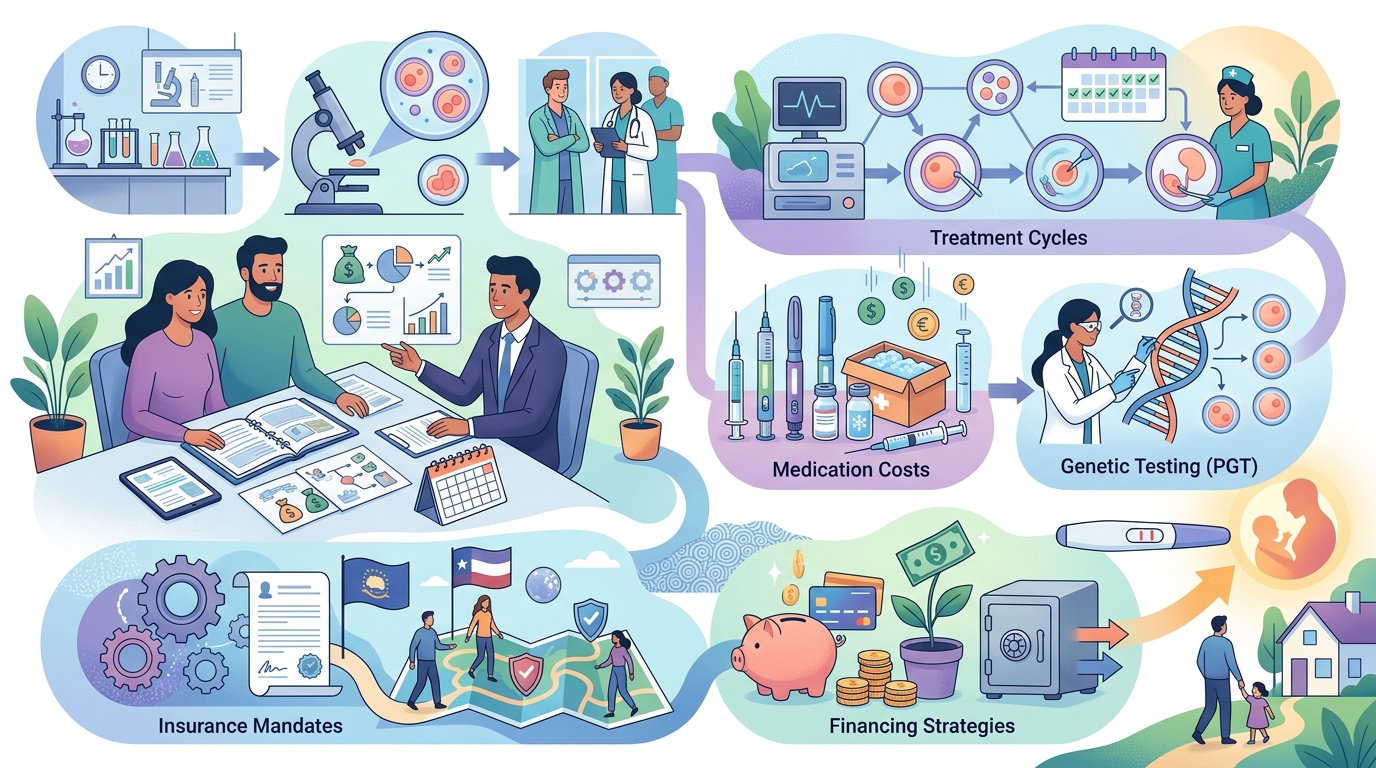
Understanding the Base Structure of IVF Cycle Pricing
Assisted reproductive technology (ART) involves complex clinical and laboratory workflows. For individuals and couples evaluating in vitro fertilization (IVF), understanding the underlying fee structures is necessary for financial planning. A single baseline IVF cycle typically carries an out-of-pocket cost ranging from $12,000 to $15,000, excluding pharmaceutical management and specialized laboratory add-ons (Source 1).
Medical literature indicates that patients frequently undergo multiple treatment cycles before achieving a live birth (Source 1). As a result, the total cumulative expenditure for a completed reproductive journey often exceeds initial clinical estimates. The overall bill is split across several distinct service categories: diagnostic clinical monitoring, surgical retrieval protocols, embryology laboratory processing, and therapeutic transfer procedures. Dissecting these line items helps patients evaluate clinic fee schedules, negotiate self-pay rates, and utilize available coverage options effectively.
Itemized Breakdown of Clinical and Laboratory Fees
A standard IVF treatment protocol is divided into sequential stages, each generating separate professional and facility charges. While some clinics bundle these services into a global package fee, others bill each component individually based on specific therapeutic requirements.
| Procedural Component | Clinical Purpose | Typical Cost Range |
|---|---|---|
| Ovarian Stimulation Monitoring | Transvaginal ultrasounds and serum hormone assays (E2, Progesterone, LH) during follicle development | $1,500 – $3,000 |
| Egg Retrieval (Oocyte Aspiration) | Surgical retrieval under conscious sedation or general anesthesia, including facility and anesthesia fees | $2,500 – $4,500 |
| Intracytoplasmic Sperm Injection (ICSI) | Direct injection of a single sperm into a mature egg for fertilized embryo creation | $1,500 – $2,500 |
| Embryo Culture & Extended Development | Incubation and laboratory monitoring of embryos up to the blastocyst stage (Day 5/6) | $1,000 – $2,000 |
| Embryo Transfer Procedure | Catheter insertion of fresh or thawed blastocysts into the uterine cavity under ultrasound guidance | $1,500 – $3,500 |
In standard insemination protocols, eggs and sperm are combined in a petri dish. However, when male-factor infertility or past low fertilization rates occur, clinics employ Intracytoplasmic Sperm Injection (ICSI). ICSI adds an extra technical fee to the core package. Furthermore, modern ART protocols increasingly favor Frozen Embryo Transfers (FET) over fresh transfers to optimize endometrial receptivity (Source 1). A dedicated FET cycle, which occurs weeks or months after egg retrieval, introduces separate fees for embryo cryopreservation, storage fees, and prep protocols.
Injectable Medication Costs and Patient Assistance Programs
Pharmaceutical management represents one of the largest variable expenses in an IVF cycle. Injectable fertility medication costs routinely range between $3,000 and $6,000 per treatment cycle. These medications are rarely included in standard clinic package rates and must be sourced directly through specialty pharmacies.
The primary medication categories required during controlled ovarian hyperstimulation include:
- Gonadotropins (Follicle-Stimulating Hormone [FSH] and Luteinizing Hormone [LH]): These hormones stimulate the ovaries to recruit and mature multiple follicles during a single menstrual cycle.
- Gonadotropin-Releasing Hormone (GnRH) Agonists or Antagonists: These suppress premature ovulation before the scheduled egg retrieval surgical window.
- Human Chorionic Gonadotropin (hCG) or Dual Trigger Injections: These induce final oocyte maturation prior to surgical aspiration.
- Progesterone Support Supplements: Administered via intramuscular injection or vaginal insert to prepare the uterine lining for embryo implantation.
Because drug protocols are tailored to individual ovarian reserve markers (such as Anti-Müllerian Hormone levels and antral follicle counts), patients requiring higher daily medication dosages incur higher pharmaceutical bills. To manage these expenses, major pharmaceutical manufacturers offer income-verified patient assistance programs. Programs like Compassionate Care or Heart+Hands provide qualified patients with tiered discounts ranging from 10% to 75% off self-pay drug retail prices. Additionally, non-profit grant organizations provide competitive grants to help cover medication invoices for self-pay patients.
Pre-Implantation Genetic Testing (PGT) Pricing and Add-Ons
Pre-implantation Genetic Testing (PGT) allows embryologists to evaluate the chromosomal or genetic status of blastocysts prior to uterine transfer. Clinical research published by the National Institutes of Health notes that screening embryos for numerical chromosomal abnormalities (aneuploidy) can improve transfer efficiency in specific patient demographics (Source 1). However, PGT is an optional add-on that adds significant cost.
PGT pricing is usually divided into two distinct billing components: the clinical biopsy fee charged by the IVF practice and the laboratory analysis fee charged by the genetics laboratory processing the samples.
| Testing Type | Primary Clinical Function | Average Cost Range |
|---|---|---|
| Trophectoderm Biopsy Fee | Surgical removal of a small cell sample from blastocysts by an embryologist | $1,500 – $2,500 per cycle |
| PGT-A (Aneuploidy Screening) | Screens blastocysts for missing or extra chromosomes (e.g., Down syndrome, Trisomy 18) | $150 – $300 per embryo (or $1,500 – $3,500 panel fee) |
| PGT-M (Monogenic/Single Gene) | Detects specific inherited genetic disorders (e.g., Cystic Fibrosis, Sickle Cell Anemia) | $2,000 – $4,500 base setup plus per-embryo fees |
| PGT-SR (Structural Rearrangements) | Screens for chromosomal translocations or inversions in known carrier parents | $2,000 – $4,000 per panel |
Because genetic testing requires freezing all biopsied embryos while awaiting laboratory reports, patients choosing PGT must also pay for frozen embryo storage and subsequent Frozen Embryo Transfer (FET) cycles. This often adds $3,000 to $5,000 in combined clinical and cryopreservation fees beyond the laboratory testing charge itself.
State-by-State Fertility Insurance Mandates
Insurance coverage for fertility treatment in the United States depends on state law and employer plan structure. State fertility mandates generally fall into two legal classifications: a 'mandate to cover' and a 'mandate to offer.'
A 'mandate to cover' legally requires health insurance carriers operating within that state to include specific fertility benefits—such as diagnostic testing, ovulation induction, or full IVF cycles—as part of standard policy benefits. Conversely, a 'mandate to offer' requires insurance companies to offer fertility coverage options to employers during policy purchasing, but leaves the decision to purchase that coverage up to the employer.
- Mandate to Cover States: States including Massachusetts, Illinois, New Jersey, New York, Maryland, and Rhode Island have established comprehensive insurance mandates that require fully insured commercial plans to cover multiple IVF cycles up to lifetime caps or cycle limits.
- Mandate to Offer States: States such as California and Texas require insurers to offer group fertility treatment options to employers, but employers are not required to provide IVF coverage in basic health benefits.
- Lifetime Benefit Caps: Mandates frequently limit coverage using lifetime financial caps (such as $10,000 to $100,000 in total treatments) or cycle-based limits (such as 4 lifetime retrieval cycles).
- The ERISA Exemption: Self-insured employer plans, governed by the federal Employee Retirement Income Security Act (ERISA), are legally exempt from state insurance mandates. As a result, employees at large self-insured corporations depend on voluntary employer benefits rather than state coverage laws.
Comparing Financing Options: Specialized Loans vs. Tax-Advantaged Accounts
When health insurance benefits are exhausted or unavailable, patients rely on out-of-pocket funding strategies. Evaluating specialized fertility loans against tax-advantaged healthcare spending accounts is essential to minimize financing costs.
Specialized medical loans provided by dedicated fertility financing firms offer structured installment plans specifically tailored to clinic fee schedules and medication orders. While these loans provide fast access to capital, interest rates range from 6% to over 30% depending on credit profile, origination fees, and loan length. Financing a $20,000 medical bill over five years at a 12% APR results in over $6,600 in cumulative interest costs.
| Financing Mechanism | Primary Advantage | Key Risk or Limitation |
|---|---|---|
| Specialized Fertility Loans | Covers complete clinical and pharmacy package with customized clinic payout terms | High interest rates (6%–30% APR) and potential origination charges |
| Health Savings Account (HSA) | Pre-tax contribution savings (federal, state, and FICA tax deductible) | Annual IRS contribution limits restrict total single-year funding capacity |
| Flexible Spending Account (FSA) | Pre-tax dollar usage available on Day 1 of plan year | Subject to annual 'use-it-or-lose-it' rules and contribution limits |
| Clinic Multi-Cycle Package | Discounted per-cycle rate when bundling multiple treatments upfront | Upfront cash requirement with potential non-refund conditions if successful early |
Using tax-advantaged accounts—such as Health Savings Accounts (HSAs) or Flexible Spending Accounts (FSAs)—allows patients to pay for eligible medical expenses using pre-tax dollars. The Internal Revenue Service (IRS) classifies IVF treatments, procedural lab fees, egg retrieval, and prescribed fertility medications as tax-deductible medical expenses under IRS Publication 502. Utilizing pre-tax funds through an HSA or FSA yields a effective discount equal to the account holder's combined marginal income tax rate (often 20% to 40% in total savings).
Multi-Cycle Bundles and Refund Guarantee Programs
To give patients fixed costs across extended care, many private clinics offer multi-cycle packages and risk-sharing refund programs. A typical refund program charges an upfront flat fee—often between $20,000 and $30,000—covering up to three full IVF cycles and unlimited frozen transfers.
Under these risk-sharing arrangements, if the patient does not achieve a live birth (or a confirmed pregnancy, depending on contract terms), the program refunds a major portion (typically 70% to 100%) of the base package fee. However, these programs enforce strict medical eligibility criteria based on maternal age, ovarian reserve indicators, and prior health history (Source 1). Medication fees and external genetic testing charges are rarely covered in these bundled guarantee programs and must still be paid out of pocket.
What is the average total out-of-pocket cost for a single standard IVF cycle?
A standard single IVF cycle averages between $12,000 and $15,000 in base clinical fees. When including injectable medications ($3,000–$6,000) and optional procedures like ICSI or PGT genetic testing, the total single-cycle cost typically ranges from $18,000 to $25,000.
What is the main difference between a state mandate to cover and a mandate to offer?
A 'mandate to cover' requires state-regulated health insurance plans to automatically include fertility benefits in their standard coverage. A 'mandate to offer' requires insurance companies to offer fertility coverage options to employers, but leaves the choice to purchase that coverage up to the employer.
Are fertility treatment expenses and medications eligible for HSA and FSA funds?
Yes. According to IRS guidelines, diagnostic fertility testing, IVF clinical protocols, egg retrievals, sperm preparation, embryo storage, and prescribed fertility medications are qualified medical expenses under IRS Publication 502, making them eligible for pre-tax HSA and FSA reimbursement.
Sources
- PMC National Library of Medicine — National Institutes of Health
This article is for general information only and is not professional advice. Figures come from public sources and change over time; check the official source before you act.
More from Real Money Net
- Heat Pump HVAC Conversion Costs: Federal Rebates, Tax Credits, and System Sizing
- Business Fiber Internet vs. Dedicated Internet Access (DIA): Architecture, Cost, and SLA Comparison
- International Medical Evacuation and Travel Health Coverage: Policy Limits and Out-of-Country Costs
- Used EV Tax Credit Rules: Eligibility, Income Caps, and Battery Degradation Checks
- Commercial Auto Insurance Coverage: Liability Limits, Business Use Rules, and Fleet Pricing
- IRS Section 25D Residential Solar Tax Credit: Sizing, Battery Rules, and ROI Calculation