The $1200 Mistake You Make Buying Dental Implants This Year
Paying for dental implants out of pocket can lead to an unexpected $1,200 loss if you ignore diagnostic coding, unbundled billing, and tax deduction rules.
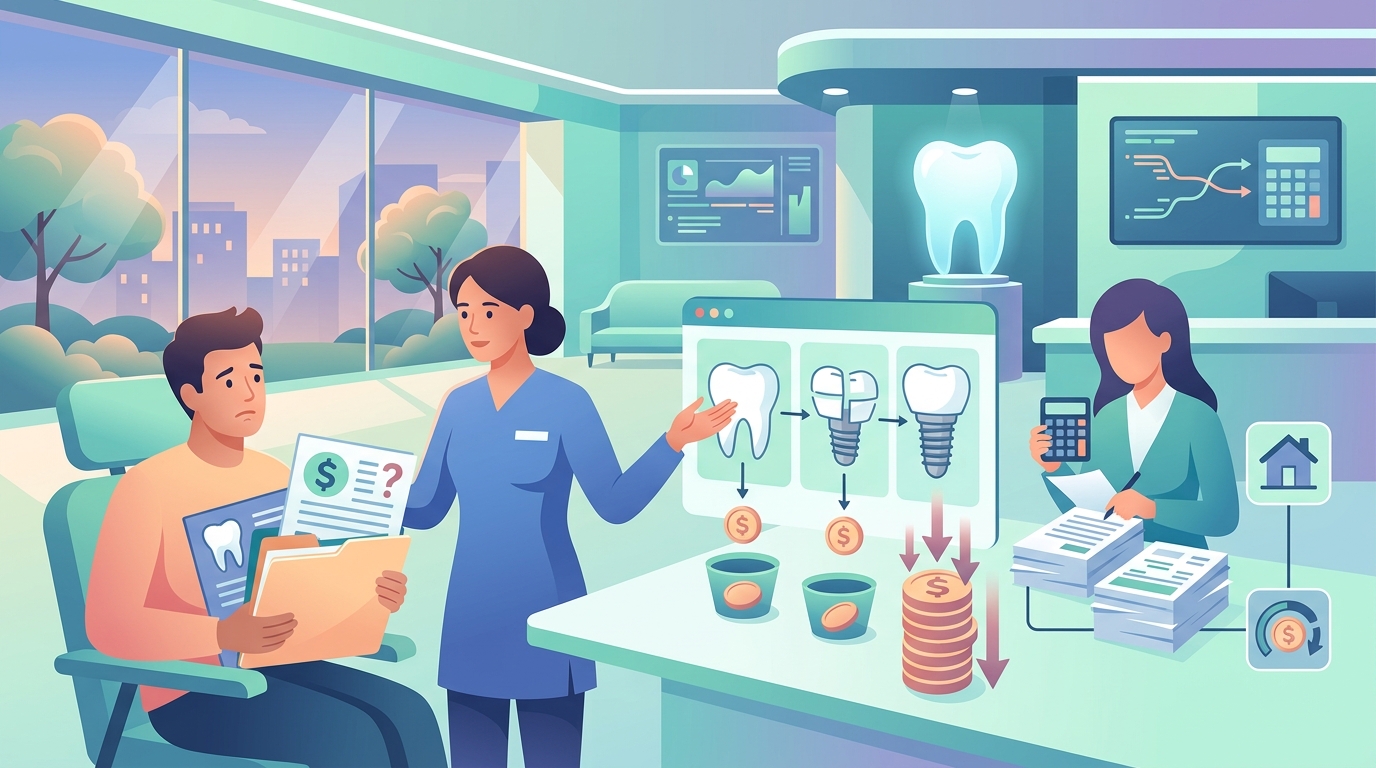
You could lose $1,200 or more on a single dental implant if you sign a treatment estimate before checking three specific billing rules. Most patients assume their quoted price covers every stage of the procedure, but unbundled imaging, separate component fees, and missed tax write-offs quickly inflate out-of-pocket costs.
Missing the Pre-Procedure Bone Density Diagnostic Code
A major financial trap occurs before the surgical post ever enters your jaw. Dental implants require adequate bone structure to support the replacement tooth (Source 2). Oral surgeons frequently perform cone-beam computed tomography (CBCT) 3D scans to measure jaw density and plan exact placement. If a clinic bills these specialized scans under general diagnostic codes, your commercial insurance plan or health savings account administrator may reject the claim, leaving you with an unexpected out-of-pocket bill ranging from $300 to $600.
Failing to pre-authorize bone grafting services can also trigger standalone facility fees. The National Institute of Dental and Craniofacial Research notes that lost jawbone must often be rebuilt prior to implantation (Source 2). When clinics separate the graft consultation from the surgical placement, patients frequently pay double for pre-operative imaging. Request the exact Current Dental Terminology (CDT) codes for diagnostic imaging before sitting in the chair to avoid duplicate diagnostic fees.
Next, discover how separate billing for abutments adds hundreds in unexpected charges.
Unbundled Abutment and Crown Billing Charges
The physical dental implant system consists of three separate parts: the titanium fixture placed in the jaw, the connector piece known as an abutment, and the final custom crown (Source 3). The U.S. Food and Drug Administration regulates these individual components as distinct medical devices (Source 3). A common $1,200 oversight happens when patients receive an initial quote that only includes the surgical placement of the titanium post itself.
Months later, once the jaw heals, the clinic issues a secondary bill for $600 for the custom abutment and another $600 for the final prosthetic crown. To avoid this surprise expense, demand an itemized pre-treatment estimate that lists CDT code D6010 for implant placement, D6057 for custom abutment, and D6058 for abutment-supported crown. If any of these codes are missing from your initial financial agreement, your total out-of-pocket cost will jump significantly higher than expected.
Read on to see why traditional Medicare coverage will not cover these costs.
Overlooking Medicare Original Coverage Restrictions
Many older adults expect Original Medicare Part A or Part B to absorb a portion of their implant expenses. However, federal regulations explicitly exclude routine dental care, including implants, extractions, and dental prostheses (Source 1). The Centers for Medicare & Medicaid Services mandates that Medicare Part A only covers dental services if you require hospitalization for an emergency or complex medical procedure where dental work is integral to the primary surgery (Source 1, Source 5).
For instance, if a patient requires jaw reconstruction following major facial trauma, inpatient dental care might qualify under Part A coverage rules (Source 5). Otherwise, standard outpatient implant procedures receive zero Medicare reimbursement (Source 1). Assuming Medicare will cover a basic implant leads patients to skip supplemental dental coverage or flexible spending allocations, creating a $1,200 deficit in expected insurance payouts.
Next, learn how the IRS tax threshold can help you recover a fraction of your expenses.
Forgetting the IRS 7.5 Percent Adjusted Gross Income Deduction
You can offset a portion of your dental implant bill during tax season if you structure your payments correctly. According to IRS Topic No. 502, you can deduct unreimbursed medical and dental expenses that exceed 7.5 percent of your Adjusted Gross Income (AGI) (Source 4). If your AGI is $50,000, medical expenses above $3,750 are deductible on your itemized tax return (Source 4).
Paying $5,000 out of pocket for a full implant system puts you $1,250 over that 7.5 percent threshold. Depending on your tax bracket, failing to claim this itemized deduction means leaving hundreds or even over $1,200 in potential tax savings on the table. Keep itemized receipts from your oral surgeon, laboratory bills, and travel records directly related to dental care, as the IRS permits mileage tracking for medical trips (Source 4).
Up next, see how medical device classifications impact material pricing.
FDA Medical Device Grading and Material Surcharges
Not all implant materials cost the same, and misunderstanding device classifications can inflate your bill. The FDA classifies dental implants and bone grafting materials as Class II or Class III medical devices depending on their design and biological safety requirements (Source 3). Premium materials, such as custom zirconia abutments or specialized human allograft bone matrices, carry higher wholesale costs than standard titanium fixtures.
Some clinics apply markup rates up to 300 percent on these specialized Class II device components (Source 3). Patients who unknowingly select proprietary or non-standard implant systems may face unexpected replacement costs later if replacement parts are hard to source. Requesting the device manufacturer name and model number ensures you are paying a fair rate based on standard insurer fee schedules rather than arbitrary clinic markups.
Below, review the complete fee schedule table to compare standard implant line items.
Comparing Typical Dental Implant Cost Components
To prevent surprise line items, examine how standard implant expenses break down across the entire treatment timeline based on standard administrative coding:
| Component Description | Standard CDT Code | FDA Medical Category | Typical Cost Range |
|---|---|---|---|
| Diagnostic 3D CT Scan | D0367 | Class II Medical Imaging (Source 3) | $250 - $600 |
| Surgical Post Placement | D6010 | Class II Endosseous Implant (Source 3) | $1,500 - $3,000 |
| Custom Abutment | D6057 | Class II Implant Abutment (Source 3) | $400 - $900 |
| Porcelain/Ceramic Crown | D6058 | Prosthetic Restorative Crown | $1,000 - $2,000 |
| Bone Grafting (per site) | D7953 | Class II/III Graft Material (Source 3) | $300 - $800 |
High-Interest Medical Financing and CFPB Protections
Financing your implant through a third-party healthcare credit card can silently add $1,200 or more in deferred interest fees. The Consumer Financial Protection Bureau warns consumers about deferred-interest financial products commonly offered at dental offices (Source 6). These plans often advertise zero percent interest for 12 months, but if a balance remains when the promotional period ends, retroactively applied interest charged from the original purchase date kicks in at rates often exceeding 26 percent (Source 6).
For a $4,000 balance, missing the repayment window by even a single day can instantly add over $1,000 in retroactive interest charges to your balance. Always review the credit terms, confirm whether interest accrues retroactively, and know your billing rights under CFPB credit guidelines before signing office payment plans (Source 6).
Finally, learn the three-step audit process to verify your dental bill.
Performing a Three-Step Dental Bill Audit
Before making your final payment or signing a financing contract, follow a structured audit process to catch billing errors:
- Request a complete itemized bill showing exact CDT codes and description lines for every single charge.
- Cross-reference those codes with your insurer's pre-determination letter or standard CMS pricing metrics to check for unbundled billing (Source 5).
- Verify whether any pre-operative diagnostic tests were billed under duplicate codes or unnecessary specialty fees.
If you identify discrepancies, submit a written dispute to the provider's billing manager before signing financing agreements or making non-refundable deposits (Source 6).
Does Medicare cover any portion of dental implant surgery?
Original Medicare Part A and Part B do not cover routine dental implants, crowns, or routine extractions (Source 1). Medicare Part A only covers inpatient hospital dental care if the procedure is medically necessary due to a complex emergency or jaw reconstruction surgery (Source 1, Source 5).
How does the IRS 7.5% threshold apply to dental implant expenses?
Under IRS Topic No. 502, you can deduct qualifying medical and dental expenses that exceed 7.5 percent of your Adjusted Gross Income if you itemize deductions on Schedule A (Source 4). Out-of-pocket implant costs, diagnostic imaging, and related travel qualify toward this threshold (Source 4).
What should I do if a dental financing card charges retroactive interest?
Review your initial contract terms to verify the promotional period rules. The Consumer Financial Protection Bureau protects consumers from deceptive billing practices and allows you to submit complaints regarding unclear deferred-interest promotion disclosures (Source 6).
Sources
- Dental Services Coverage — Centers for Medicare & Medicaid Services
- Oral Health Information and Dental Research — National Institute of Dental and Craniofacial Research
- Medical Devices Regulation and Safety — U.S. Food and Drug Administration
- Topic No. 502 Medical and Dental Expenses — Internal Revenue Service
- Medicare & Medicaid Services Policy and Coverage — Centers for Medicare & Medicaid Services
- Consumer Financial Protection and Billing Rights — Consumer Financial Protection Bureau
This article is for general information only and is not professional advice. Figures come from public sources and change over time; check the official source before you act.
More from Real Money Net
- The $12,000 Deposit Mistake You Make With Local Builders
- Cut $5,000 Off Construction Bids With This Quick Tax Verification
- Contractors Keep Hiding This $3,000 Clause In Your Local Bids
- How Your ZIP Code Unlocks $10,000 Construction Savings Today
- The $840 Mistake You Make Before Buying New Insurance
- The Simple IRS Form That Cuts Your Bills by $610