Check If Your Dental Practice Qualifies for Zero Dollar Software
Discover how IRS business deduction rules, FDA medical device classifications, and vendor bundling promotions allow clinical practices to access dental implant planning software with zero upfront cost.
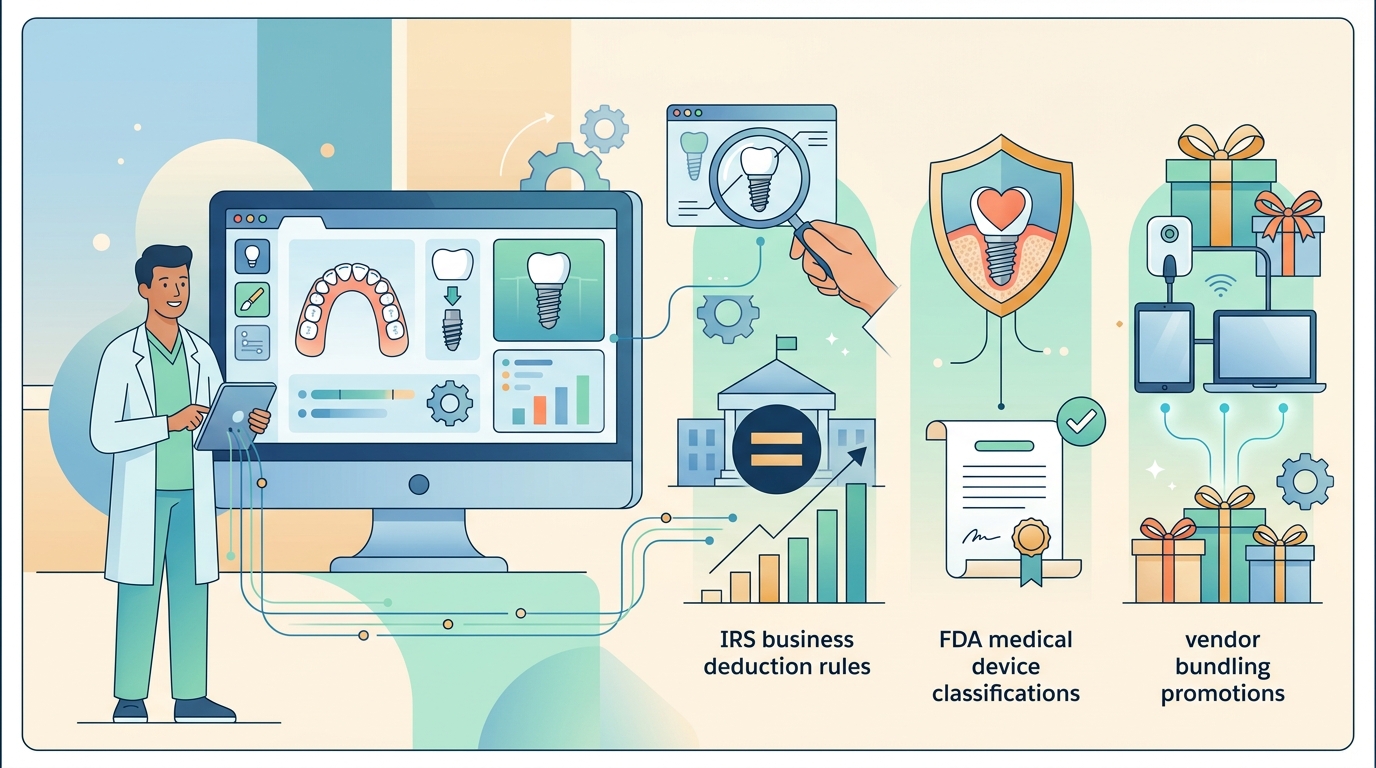
Acquiring advanced dental implant planning software does not always require a massive upfront capital investment. By leveraging specific vendor promotional structures, open-source clinical platforms, and tax deduction guidelines, practice owners can legally obtain software tools for zero dollars upfront.
The Mechanism Behind Zero-Dollar Dental Software Offers
Software manufacturers and distributors often deploy entry-level software tiers at zero initial acquisition cost to build brand loyalty and expand their user base. These zero-dollar tiers typically grant full or limited access to three-dimensional treatment planning tools, surgical guide creation, and cone beam computed tomography (CBCT) integration. The Federal Trade Commission (FTC) regulates commercial offers to ensure that terms like free or zero dollar are clearly defined and not deceptive to commercial buyers (Source 3).
In many commercial models, the software itself carries a zero-dollar retail tag, while revenue is generated through per-case export fees, surgical guide manufacturing orders, or cloud storage upgrades. Dental practices can evaluate these pricing tiers to identify whether their operational volume justifies a zero-dollar software model over a recurring subscription or perpetual license. Next, we examine how federal safety classifications impact these software options.
FDA Regulatory Classifications for Implant Planning Software
The U.S. Food and Drug Administration (FDA) regulates dental implant software as a medical device to protect patient health and safety (Source 2). Software used to design surgical guides or analyze bone density prior to implant placement must meet specific regulatory clearances under FDA device frameworks (Source 2). Whether a software package is offered as a zero-dollar download or a premium platform, clinical users must ensure the software maintains appropriate FDA clearance for surgical planning (Source 2).
Practices considering zero-dollar options should verify that the software manufacturer has completed the necessary regulatory submissions before utilizing the platform in active patient care (Source 2). FDA compliance ensures that the software algorithms accurately translate 3D imaging into physical surgical guides, protecting the clinic from regulatory exposure and liability. In the following section, we analyze how federal tax codes assist with software costs.
IRS Section 179 and Business Expense Deductions
The Internal Revenue Service (IRS) permits businesses to deduct ordinary and necessary expenses incurred in operating a trade or business (Source 1). Under IRS rules, off-the-shelf software purchased for business use can often be fully deducted or amortized depending on the practice's tax structure and capitalization thresholds (Source 1). When a vendor provides software with zero upfront cost, the practice must accurately record associated operational fees as ordinary operating expenses (Source 1).
If a practice acquires software bundled with hardware—such as an intraoral scanner or CBCT machine—the overall package cost may qualify for immediate deduction under IRS Section 179 (Source 1). This tax treatment effectively reduces the net cost of software adoption to zero or near-zero when balanced against overall practice income tax liabilities. Next, we break down how vendors construct software and hardware bundle promotions.
Hardware Bundling and Freemium Software Promotional Tactics
A common method for practices to obtain zero-dollar dental implant planning software is through hardware purchase agreements. Dental equipment manufacturers frequently include lifetime software licenses or zero-cost initial software packages when a practice purchases imaging equipment, digital impression scanners, or 3D printers. According to FTC guidelines on business compliance, commercial terms associated with bundled promotions must be clearly disclosed prior to transaction completion (Source 3).
Practices can negotiate bundled software agreements during major capital equipment acquisitions. By linking the software cost directly into the hardware purchase, the line-item expense for the software itself becomes zero dollars on the final purchase contract. Up next, we review how FTC compliance protects practice owners from misleading software claims.
FTC Standards and Advertising Transparency in Dental Technology
The Federal Trade Commission enforces rules against unfair or deceptive business practices, ensuring that vendors state full terms when promoting zero-dollar software (Source 3). Software vendors are required to explicitly state if a free software offer contains trial duration limits, mandatory export charges, or recurring cloud hosting requirements (Source 3). Transparency allows practice managers to distinguish genuine zero-cost entry tiers from temporary trials.
When reviewing promotional materials from dental software reps, practice leaders should request a written disclosure of all mandatory long-term costs (Source 3). Evaluating these disclosures helps ensure the practice does not encounter unexpected operational expenditures after integrating the software into daily clinical workflows. In the next section, we evaluate total cost of ownership models.
Calculating the True Total Cost of Ownership for Dental Software
While initial software installation costs may be zero dollars, practice owners must evaluate ongoing operational metrics. Software programs require maintenance, staff training, cloud backups, and periodic feature updates. Understanding these long-term expenses allows practice administrators to accurately contrast zero-dollar per-case software against upfront perpetual software models.
- Per-case export fees: Costs incurred each time a surgical guide or treatment plan is exported for printing or manufacturing.
- Annual maintenance contracts: Fees for technical support, security patches, and regulatory compliance updates.
- Cloud storage tier costs: Monthly charges based on patient imaging volume and data retention schedules.
- Training and onboarding costs: Expenses associated with staff education and clinical integration.
By calculating the projected annual case volume against per-case export fees, a practice can determine whether a zero-dollar upfront model saves money over a fixed annual subscription model. The following section provides concrete qualification criteria for practice owners.
Qualification Checklist for Practice Owners
To determine whether a practice qualifies for zero-dollar implant planning software programs, practice leaders should evaluate key operational criteria across tax, legal, and clinical categories.
- Clinical Imaging Capability: Possession of compatible CBCT or intraoral scanning hardware that outputs standard DICOM or STL files.
- IRS Trade or Business Status: Operation as a active clinical practice eligible for business expense deductions under IRS guidelines (Source 1).
- Regulatory Clearance Verification: Ensuring target software carries active FDA medical device clearance for surgical planning (Source 2).
- FTC Contract Verification: Verifying that all promotional terms and mandatory fees are fully disclosed in writing (Source 3).
Comparing Software Acquisition Models
| Acquisition Model | Upfront Software Fee | Operational / Per-Case Fee | Regulatory & Tax Considerations |
|---|---|---|---|
| Zero-Dollar Freemium | $0 | Per-export or per-guide fee applies | Requires FDA cleared software status (Source 2); export fees deductible under IRS rules (Source 1). |
| Hardware-Bundled | $0 (Included with equipment) | Low or zero recurring fees | Capital purchase eligible for IRS Section 179 deduction (Source 1); must follow FTC bundling rules (Source 3). |
| Perpetual License | High initial cost | Annual support fee optional or required | Software capitalized or expensed per IRS rules (Source 1); full FDA medical device compliance required (Source 2). |
| Monthly Subscription | Zero to low initial fee | Fixed recurring monthly cost | Deductible as ordinary and necessary business operating expense under IRS guidelines (Source 1). |
Can a practice legally obtain dental implant software for $0 upfront?
Yes. Dental practices can obtain software for $0 upfront through freemium software models, open-source platforms, or equipment bundling promotions that comply with FTC guidelines (Source 3).
Are per-case export fees tax deductible for dental practices?
Yes. Per-case export fees and ongoing software subscription costs are typically deductible as ordinary and necessary business expenses under IRS business deduction rules (Source 1).
Does zero-dollar software need FDA medical device clearance?
Yes. Any software platform used for clinical diagnosis, treatment planning, or surgical guide creation must maintain appropriate FDA medical device clearance regardless of purchase price (Source 2).
Sources
- Deducting Business Expenses — Internal Revenue Service
- Dental Devices Overview — U.S. Food and Drug Administration
- Business Guidance and Compliance — Federal Trade Commission
This article is for general information only and is not professional advice. Figures come from public sources and change over time; check the official source before you act.
More from Real Money Net
- The $1200 Mistake You Make Buying Dental Implants This Year
- Dentists Use This 30 Second Check To Drop Implant Bills
- The Fine Print That Drops Dental Implant Bills By $2400
- Check If Your ZIP Code Qualifies For $89 Dental Implants
- The $2,400 Mistake You Must Avoid Before Getting Dental Implants
- Dentists Reveal The $1,200 Dental Grant Application Trick